

Assumptions, results and research status
A guided research section joining exact finite models, conditional reconstruction and open physical identification problems.
A local choice can carry a global question
A vector can have different components in different bases while representing the same physical state. Gauge geometry makes that familiar freedom local: each place or record can carry its own frame. To compare states across an edge, one needs a transport map. To compare two histories with the same endpoints, one must also retain how their transport differs.
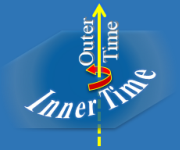
The Single Monad Model and Duality of Time Theory place this comparison problem inside a proposed passage from inner generation to outer completed records. If future interference can distinguish two histories, a completion that merges them has discarded relevant information. The resulting research question is precise: which relational structures must survive, which symmetries preserve those structures, and which explicit dynamics generates their observable response? [Completed records, v21]
This section develops those stages in detail. Begin with the local-frame guide, follow transport around a loop, and use the interactive four-link example to change frames without changing the loop trace. The reading paths offer longer routes for first-time readers, mathematicians and researchers.
From comparison to the retained symmetry group
The endpoint law U′yx = gyUyxgx−1 follows from expressing the same comparison in new local frames. It does not select a particular group or an interaction strength. Those further questions depend on what the carriers contain and which tensors a completed record retains.
The rank-three/rank-two example makes this dependence visible. Retaining only a combined metric allows U(5). Retaining the two blocks gives U(3) × U(2). Retaining a global parallel product-volume tensor reduces this to S(U(3) × U(2)); fixing the two volume tensors separately gives a different subgroup. The retained-structure explorer lets you inspect each choice and test the associated global quotient condition. [Sevenfold reconstruction, v18]
The sevenfold-recurrence article explains the additional source, quadrature, marked-cut and scalar-extension assumptions used to obtain the example carriers. Six inner generative levels are nested roles leading to seventh, outer completion. The separate cycle sizes and projection counts used in numerical examples do not create independent physical time axes.
Calculate a response from an explicit model
A transport law specifies how a comparison behaves under frame changes. An energy response requires a Hamiltonian. The four-position singlet model supplies one: a mobile carrier is paired with a stationary dual through a positive singlet penalty and moves through prescribed links. Its ground energy is determined by a finite secular equation, and its excitation gap has an exact lower bound under the stated assumptions.
E(W) = Δ − z, gap ≥ Δ/(4m).λak = 2t cos[(θa + 2πk)/4]. This is a finite singlet-loop model with specified hopping and penalty.
Use the singlet explorer to compare the exact energy with the leading loop term. The derivation explains the physical root, uniqueness and gap; the Hessian article explains how a local curvature response is extracted. The effective-interaction guide then states what changes when links themselves become dynamical. [Exact loops, v20]
Connect spectral geometry to a physical field theory
A protected eigenspace can move as external parameters vary. Its projector then defines a vector bundle, and projected differentiation supplies a connection. The spectral-bundle article develops that construction, while the finite-projection explorer displays geometric phase and survival probability around one explicit loop.
From there, the section separates several deeper tasks: specify a finite spectral geometry; supply chiral matter and test anomalies; normalize the action and match physical couplings; construct the vacuum of a regulated gauge Hamiltonian; control low/high mixing; and take thermodynamic and continuum limits. The status ledger identifies the inputs and unresolved steps in each route.
The distinction between an auxiliary fiber eigenvalue and a physical mass is especially useful. The twisted-cycle explorer shows a charged mode softening as its holonomy approaches identity. The vacuum-window explorer shows why a low window containing the projected vacuum cannot support a strictly positive excitation bound on that vector. These examples turn an abstract proof obligation into an inspectable calculation. [Vacuum obstruction, v2]
Continue into the advanced calculations
The expanded section now contains seventy pages, including ten interactive explorers. Eighteen advanced guides develop complete channel examples, loop reconstruction, two-angle SU(3) holonomy, determinant-line counterexamples, projector transport, compression defects, vacuum-aware reduction and limiting estimates. The new material begins where the introductory calculations leave a precise question open.
What survives completion?
Compare erasing a classical label with depolarizing a quantum reference. Inspect the density matrix, reduced states and joint correlations.
What does a spectrum leave open?
Hold the two-level spectrum fixed while changing a rank-two projector's curvature and loop holonomy.
What remains after the vacuum?
Complete the vacuum inside a three-state model and calculate the positive coefficient on a nonzero punctured low space.
The six project briefs turn these examples into focused invitations to collaborate. The site connection map follows the relevant objects into quantum theory, time, symmetry, matter, hydrogen, derivations and experiments.
Use the section as a working research resource
The articles include assumptions, equations, intermediate arguments, counterexamples, worked calculations and questions for further research. Ten explorers export their inputs, units and numerical results. The reference library includes all twelve supplied manuscripts with version notes, alongside conventional gauge-theory references. The exercise collection provides short checks that can be reproduced independently.
I welcome collaboration with experts in physics, mathematics and philosophy. Contributions can focus on a proof, a counterexample, a numerical construction, a source-to-observable map or the meaning of predictive completion. The collaboration page gives concrete starting questions. Follow the research blog, the gauge update log, or the gauge RSS feed for developments.
Explore all guides and tools
Browse the complete section. Every guide remains available when JavaScript is disabled.
69 guides and explorers
Start and navigate
Choose a path through gauge structure
Guided routes from local frames to gauge transport, completed records, exact models, spectral geometry and the constructive lattice programme.
Read the guide →Connect gauge structure to the rest of SMONAD
A question-led map from gauge records, geometry and dynamics to hydrogen, matter, quantum theory, time, derivations, experiments and philosophy.
Read the guide →Gauge glossary and notation
Definitions of fifty gauge, record, spectral and lattice terms, with consistent transport signs and links to detailed derivations.
Read the guide →Questions about gauge structure in SMM/DTT
Twenty detailed answers about gauge frames, records, sevenfold recurrence, exact loops, anomalies, vacuum gaps and the scope of unification claims.
Read the guide →Gauge reference library
Twelve gauge manuscripts, source-version notes, conventional references and connected SMONAD derivations.
Read the guide →Gauge section updates and research notes
Follow revisions to the gauge articles, new research-blog notes, source versions and the dedicated gauge RSS feed.
Read the guide →Records and transport
Local frames and the relational origin of gauge freedom
Derive the endpoint gauge law, distinguish passive frames from physical reference states, and identify the assumptions needed to compare completed records.
Read the guide →Gauge observables, coherent comparisons, and Gauss sewing
Construct invariant quantities, compare coherent and singlet-return tests, and show why density-matrix twirling does not select the neutral Gauss sector.
Read the guide →Completed records, selector forgetting, and retained references
Analyze the exact standard-form completion channel, its fixed algebra, its erasure obstruction, and the joint reference data that local forgetting must preserve.
Read the guide →Predictive sufficiency and the descent of transport to records
Define behavioral completion, prove the interference obstruction to endpoint-only records, and identify the conditions for updates and transport to descend.
Read the guide →Mathematical structure
Parallel transport between completed records
Follow ordered links, derive the differential connection, construct polar-overlap comparisons, and distinguish geometric transport from physical evolution.
Read the guide →Holonomy, curvature, and the information carried by loops
Distinguish closed transport, local curvature, and global topology; calculate loop invariants and understand the extra information in noncommuting cycles.
Read the guide →Completion channels: exact erasure, preserved algebras and residual memory
Calculate the spectrum, Kraus form and dilation of the selector channel, distinguish linear invertibility from physical reversal, and test what its fixed algebra preserves.
Read the guide →Real commutants and the selection of quantum phase
How real dynamics can select a complex phase, and why this does not select the Standard Model.
Read the guide →The conditional sevenfold recurrence
How the stipulated source, quadrature and reset rules produce a triplet, a cut doublet and exact response ratios.
Read the guide →Wilson-loop tomography: which measurements determine the transport?
Recover complex traces with calibrated interference, reconstruct a single SU(3) conjugacy class, and show why separate loop traces miss relational information between noncommuting cycles.
Read the guide →The full SU(3) holonomy domain: alcoves, traces and exact response
Parametrize every SU(3) conjugacy class, derive the deltoid trace domain, and compare inequivalent equal-real-trace loops through the exact finite singlet Hamiltonian.
Read the guide →How eliminating auxiliary variables creates interactions
Derive exact block elimination, virtual-loop responses and constrained mediator laws, then identify the errors and preparation conditions required for reliable effective dynamics.
Read the guide →When compressed observables form an algebra
Use explicit two- and three-state calculations to distinguish compression, operator systems, corner algebras and closed effective dynamics.
Read the guide →Spectral cutoffs, finite rank and the order of limits
Distinguish smooth filters from projections, quantify projector regularity, and calculate exactly why finite spectral windows do not retain an ultraviolet heat dimension.
Read the guide →Reflection positivity from a vacuum Markov process
Derive the antilinear reflection form, reconstruct a two-state example exactly, and distinguish positive weights, reversible kernels, positive transfers and continuum OS requirements.
Read the guide →The vacuum obstruction to a sharp low-energy window
Prove why an unpunctured relative-mixing bound fails when a multiplication window splits the positive vacuum, and derive the transported-vacuum repair.
Read the guide →Feshbach reduction with the vacuum and domains intact
Derive bounded and quadratic-form Schur complements, their exact positivity criteria and quantitative margins, with the vacuum removed before strict estimates.
Read the guide →A nonempty low space after vacuum puncture
Work through an exact three-state transfer model whose rank-two low window leaves a positive rank-one Schur form after the transported vacuum is removed.
Read the guide →Counterexamples that locate a gap proof’s missing premise
Use exact operators to distinguish pointwise from uniform gaps, vacuum-tail constraints, semigroup compression, mixing scales and sufficient contraction assumptions.
Read the guide →Resolvents, moving Hilbert spaces and stable spectral bands
Compare exact block resolvents, disappearing high components, norm-stable Riesz projections and vacuum-compatible Mosco recovery with concrete counterexamples.
Read the guide →Worked exercises in gauge structure
Eighteen reproducible exercises with solutions covering transport, exact singlet roots, determinant groups, anomalies, projected geometry and vacuum reduction.
Read the guide →Exact loop models
Shared-reference protocols: what label erasure leaves observable
Compare Bell-reference preservation with actual reference depolarization, derive exact correlation and entanglement diagnostics, and distinguish marginal preservation from a fixed carrier algebra.
Read the guide →Singlet loops: a supplied microscopic Hamiltonian with a generated response
Build the four-position carrier–dual singlet model, derive its fourth-order loop term with folded corrections, and separate coherent completion statistics from energy response.
Read the guide →The exact singlet-loop response and protected auxiliary gap
Derive the holonomy-dependent resolvent, prove uniqueness and the exact finite auxiliary gap, and solve the physical branch without relying on perturbation theory.
Read the guide →The exact holonomy Hessian and its two-block constraint
Derive the exact static singlet stiffness, track the factor-of-two convention, and distinguish the model’s central-response relation from general gauge-invariant dynamics.
Read the guide →Unitary return protocols: coherent histories, exact amplitudes and measurement timing
Derive exact singlet-return amplitudes from a reduced bright matrix and all secular poles, calculate the short-time loop signal, and show how intermediate measurements change the experiment.
Read the guide →Research and collaboration
Reconstructing the gauge group from retained structure
Follow the conditional source-to-carrier construction, derive the product-volume stabilizer and its Z6 quotient, and identify the reference and global geometry assumptions.
Read the guide →Falsifying a finite model: controls, calibration and predictions kept separate
Design tests that distinguish the exact singlet and channel models from their approximations, calibrate parameters on reserved data, and state precisely what a failed or successful prediction establishes.
Read the guide →Gravity and the meaning of unification
Distinguish common geometric language, common dynamics, structural selection and a predictive quantum theory.
Read the guide →Protected completion bands and their geometric corrections
Separate a proved tangent stiffness from a nonlinear quantum band, derive its Kato connection and Born–Huang correction, and state the exact local-to-global obligations.
Read the guide →Projected lattice theory and the dangerous cluster
Trace the conditional chain from an invariant projected sector through high-energy coercivity, Feshbach reduction and finite-dimensional model margins to large-volume transport.
Read the guide →What a mass-gap result would have to prove
Separate finite spectra, auxiliary thresholds, neutral gaps, volume-uniform estimates and a continuum Yang–Mills construction, with exact transfer and correlation criteria.
Read the guide →The continuum limit: convergence, gap transfer and identification
Follow the declared regulator sequence through renormalized observables, reflection positivity, comparison-space convergence, auxiliary invisibility and intrinsic Yang–Mills identification.
Read the guide →A concrete roadmap for the lattice proof obligations
Turn the source’s conditional theorem into reviewable tasks: exact domains, a uniform conditional SU(2) band, global vacuum patching, cross-form estimates, physical coercivity and continuum identification.
Read the guide →Gauge research: assumptions, results and open problems
A claim-by-claim ledger for gauge transport, retained symmetry, exact singlet loops, protected geometry, anomalies, vacuum coercivity and continuum identification.
Read the guide →Gauge research projects for collaboration
Six concrete projects with prerequisites, reproducible starting calculations, expected outputs and explicit criteria for assessing a contribution.
Read the guide →Collaborate on gauge structure, dynamics and foundations
An invitation to physicists, mathematicians and philosophers, with concrete research questions on records, gauge groups, exact loops, spectral geometry and continuum limits.
Read the guide →Spectral geometry
Determinant lines, parallel volume and global holonomy
Calculate the distinction between a local trace constraint and a globally parallel product-volume tensor, including flat counterexamples and discrete root choices.
Read the guide →Winding, charge and global gauge structure
Separate phase winding, integer representation weights, Chern classes and physical electric charge.
Read the guide →Protected spectral bundles and connection geometry
From isolated eigenspaces to Kato transport, with exact curvature examples and explicit physical limits.
Read the guide →Geometric phase and finite projection protocols
An exact two-state example separates loop phase, projection survival and autonomous gauge dynamics.
Read the guide →An exact projector with variable curvature and a fixed spectrum
Calculate the frame, projector, connection, curvature and circle holonomy of a rank-two graph family, then separate coordinate geometry from physical gauge dynamics.
Read the guide →Kato transport, projection sequences and physical evolution
Derive the exact horizontal transport equation, compare it with Schrödinger dynamics in a rotating two-state model, and calculate projection loss and geometric kinetic terms.
Read the guide →Temporal operator algebras and spectral geometry
Bounded algebras, Dirac operators, spectral distance and inner fluctuations with their domains made explicit.
Read the guide →Matter and interactions
Worked representations, quotient tests and anomaly sums
Derive the full even exterior module, its characters, local anomalies and trace weights, then test the assumptions that separate one generation from an arbitrary representation choice.
Read the guide →The spectral action and its conditional physical content
How a specified Dirac operator produces gravitational, gauge and scalar densities through heat-kernel asymptotics.
Read the guide →Matter representations and anomaly cancellation
A conditional exterior construction of one generation, with exact charges, quotient checks and anomaly sums.
Read the guide →Couplings, normalization and electroweak mixing
Representation traces, matching relations, renormalization and the independent problem of particle masses.
Read the guide →Lattice and vacuum
The auxiliary cycle: exact spectra and their limits
Construct covariant differences on a discrete auxiliary circle, derive the holonomy-twisted spectrum, and understand the constant modes that compactification does not remove.
Read the guide →The exact finite-regulator Hamiltonians
Specify the gauge Hilbert space, heat-kernel transfer operator and Friedrichs completion Hamiltonian, with their domains, normalization and precisely limited gap conclusions.
Read the guide →The vacuum and outer-time reconstruction
Follow the positive transfer operator to its unique vacuum, reversible Markov representation and reflection-positive reconstruction, while keeping finite periodic trace states distinct.
Read the guide →Charged thresholds, neutral modes and auxiliary invisibility
Distinguish auxiliary translation charge from gauge charge, show why a charged threshold leaves neutral dynamics open, and state the stronger conditions needed to remove the auxiliary sector.
Read the guide →Character sectors: exact reduction and uniform estimates
Derive finite cyclic projectors, charged correlator bounds and complement thresholds, then test growing character sets and neutral auxiliary observables with exact examples.
Read the guide →Interactive explorers
Explore local frames and gauge-invariant loops
Change SU(2) links and local frames, inspect the exact loop matrices, and compare trace invariance with three distinct loop readouts.
Open the explorer →Explore exact singlet-loop energies and gaps
Solve the physical secular root for a four-position singlet model, compare exact and weak-hopping loop energies, and inspect the finite excitation gap.
Open the explorer →Explore a holonomy-twisted auxiliary cycle
Compute exact finite-cycle Laplacian eigenvalues, compare twisted and untwisted fibers, and inspect the loss of a uniform floor near identity holonomy.
Open the explorer →Explore block reduction and the completed vacuum
Compare exact two-block eigenvalues with a Schur complement and inspect the vacuum correction that makes a low-window Schur value vanish.
Open the explorer →Explore retained tensors and the gauge group
Compare stabilizers for retained metric and determinant data, test the Z6 representation condition, and calculate central trace weights.
Open the explorer →Explore one-generation anomaly cancellation
Change integer charges in a fixed all-left-handed matter spectrum and inspect local anomaly coefficients, Witten parity and Z6 quotient descent.
Open the explorer →Explore geometric phase through finite projections
Multiply exact rank-one latitude projections, compare finite and continuous geometric phase, and inspect survival probability and singular overlaps.
Open the explorer →Completion, marginals and a shared Bell reference
Compare label erasure with reference depolarization and inspect exact density matrices, local marginals, correlations, purity and negativity.
Open the explorer →Projector curvature with an unchanged spectrum
Change a rank-two graph embedding while keeping its Hamiltonian spectrum fixed; inspect connection, curvature, projector, loop holonomy and matrix residuals.
Open the explorer →A nonzero vacuum-punctured low window
Calculate a three-state vacuum-corrected Schur complement with a one-dimensional nonzero punctured low space, and compare transfer-form margins with logarithmic energies.
Open the explorer →Sources for this guide
- Completed records, v21
- Temporal completion and exact loops, v20
- Sevenfold reconstruction, v18
- Vacuum obstruction and form Feshbach, v2
Source manuscripts, version notes, and standard references are listed in the reference library.