


The answer in brief
The selected grammar yields 137 distinguishable records. A physical coupling also needs a source-selected response and an independently normalized measurement.
Go to the research challengeWhy begin with ten continuation modes?
Let a three-dimensional readout module be enlarged by an identity channel, giving a four-dimensional envelope V. The identity is an operational component, not a fourth spatial direction. If the task is to retain every symmetric bilinear input distinction without extra relations, its receiver is Q=Sym²V. Four diagonal pairs and six unordered mixed pairs give dimension ten.
For an orthonormal input basis, mixed modes are (eₐ⊗eᵦ+eᵦ⊗eₐ)/√2. Their normalization matters when the receiver is used for probabilities or response. Quaternionic multiplication supplies a useful comparator: its symmetric product maps this ten-dimensional space onto four dimensions and loses six independent distinctions. Thus the larger receiver means retained pair information. Its physical preparation and continued accessibility are substantive memory assumptions.
How the grammar produces 137
At depth d use a d-dimensional innovation space and retain its nonempty exterior branches. The basis count is bd=Σk=1dbinom(d,k)=2d−1, giving one, three and seven branches. Declare R₀=0 and Rd=(Q⊗Rd−1)⊕Bd. A continuation preserves all ten labels, while a terminal branch is kept in a distinct direct-sum sector.
The three final forms are two continuation symbols followed by a depth-one terminal, one continuation followed by a depth-two terminal, and an immediate depth-three terminal. Typed symbols and the stopping rule make their parsing unique. These are free retention assumptions, not consequences of decimal notation or of merely observing three spatial directions.
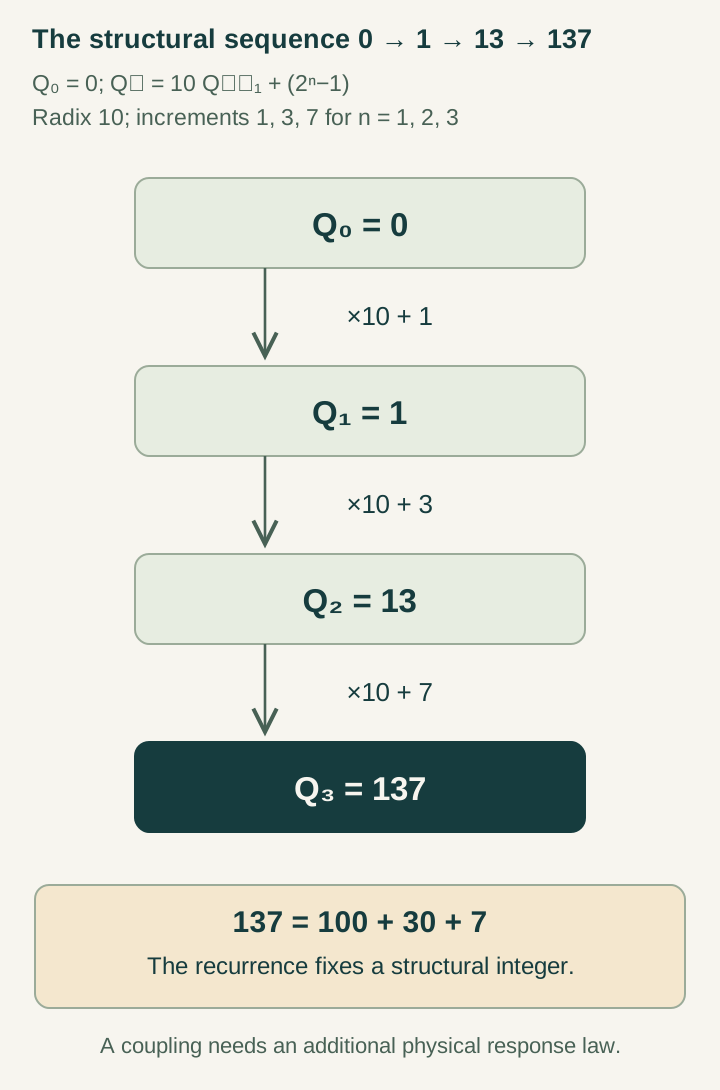
Open the full-size diagram →
What operational minimum does that count imply?
Suppose every legal word must be identified without error in one readout from an encoded pure state ψᵢ. Measurement effects Eᵢ are positive and sum to identity. Perfect discrimination requires Eᵢψᵢ=ψᵢ and Eᵢψⱼ=0 for j≠i. Consequently ⟨ψᵢ,ψⱼ⟩=⟨ψᵢ,Eᵢψⱼ⟩=0. All 137 states must be orthogonal.
A receiver of dimension at least 137 is therefore necessary for this declared one-shot task, and the free basis attains the bound. This establishes a concrete informational meaning. A task allowing errors, sequential interrogation or fewer questions can require different resources. Conversely, additional physical relations identifying words reduce the free rank. The source model must establish that all counted distinctions survive completion and the future tests actually used.
The stopping rule also matters physically. Including an empty exterior branch would change the increments from one, three and seven to two, four and eight. With the same ten-mode continuation and zero initial receiver, the successive dimensions become two, twenty-four and 248. This calculation does not propose a competing value for alpha; it identifies exactly which record convention the source must select to make 137 necessary within the grammar.
Does a count make every outcome equally likely?
No: an explicit comparison shows the remaining choice. A uniform final-word sampler assigns each word probability 1/137. Another sampler chooses uniformly among local available terminals and continuations. At the final depth there are seventeen choices; at the preceding depth thirteen. It gives each of seven immediate terminal words probability 1/17 and each of the 130 longer words probability 1/221.
Both samplers use the same receiver and normalize exactly. Only the first makes each word equally likely. An inverse rank can therefore arise as a probability under one preparation without being forced by the dimension itself. In DTT language, generating a receiver, selecting its state and exposing a completed outcome are related but different operations. Their connection must be specified dynamically.
How can the same count yield different response?
For a positive stiffness operator K and source vector f, the quadratic capacity is C=⟨f,K⁻¹f⟩. The inverse weights each accessible mode by its response, not merely by its existence. Give the 100-, 30- and 7-dimensional sectors isotropic stiffnesses κ₁,κ₂,κ₃ with ordinary trace coupling. Then C=100/κ₁+30/κ₂+7/κ₃.
Equal stiffnesses κ give C=137/κ. Doubling only the first sector gives C=87/κ, because fifty plus thirty plus seven is eighty-seven. The record grammar is unchanged, and both choices preserve symmetry within each sector. Even a stronger symmetry enforcing equal stiffnesses leaves the common overall scale free. This countermodel identifies the required source theorem: select the response weights and normalize them against independently identified action, speed and unit current.
Why a 137-fold phase closure needs its own action
A phase can act with different weights on different grammar sectors. In the inherited polynomial action, an envelope vector has weight one, a symmetric pair weight two and an exterior k-product weight k. The resulting weight polynomial is P(z)=3z+3z²+21z³+10z⁴+100z⁵. Its dimension is P(1)=137, but its total phase weight is P′(1)=612.
The inherited determinant is therefore z⁶¹². Selecting instead a common output action zI gives determinant z¹³⁷ and a 137-fold determinant-one condition. Both calculations are exact for their stated actions. Removing labels from a description does not physically change one action into the other. The completion mechanism must explain why its observable phase uses the common output action if that closure is part of the coupling argument.
What would convert the integer into a prediction?
A conditional continuum response gives gN=scont/(4πacN). With N=137, the ideal value 1/137 additionally requires scont=4πac and an electromagnetic identification of the source and matter sector. This dimensionless equality cannot be obtained by changing measurement units. It is the physical normalization target.
The structural integer is not measured inverse alpha and is not a running-coupling calculation. A stronger SMM/DTT model would derive its grammar, response and common action–clock dictionary from one law, freeze independent calibrations and predict another observable. The exact count then becomes one constraining part of a joint explanation. Keeping these stages explicit makes the 137 programme both more ambitious and more readily assessable.
What is the difference between 137 modes and an eight-bit register?
The one-shot discrimination bound fixes a task-dependent state-space dimension. It does not say that a computer must contain 137 binary memory cells. Seven binary cells label at most 128 alternatives, while eight label 256, so an eight-bit classical register can encode the 137 word labels with 119 unused addresses. Likewise, an unrestricted eight-qubit Hilbert space is large enough to contain 137 mutually orthogonal states. Encoding the labels this way does not remove the need for 137 distinguishable preparations when the whole one-shot task is retained.
This distinction resolves an apparent objection about compression. A compact program can describe a large family of states without making the states physically identical. Conversely, a compressed receiver that answers only a smaller family of questions may require fewer states. The construction must specify whether it is preserving the full word, its terminal depth, a response amplitude, or only a final spatial coordinate. These are different operational demands and therefore support different minimality statements.
Which counted distinctions survive completion?
Consider the 137-dimensional free receiver and a completion map that records only the terminal sector. It has three possible output labels: the 100-word, 30-word and seven-word sectors. Although the source contains 137 words, a single terminal-sector reading distinguishes only three classes. To retain the full bound, the permitted future tests must separate the words inside each class. A later test that accesses a stored continuation label can do so; a rule that permanently erases those labels cannot.
A concrete audit is a response table whose rows are the legal words and whose columns are permitted completed tests. Two rows that agree in every column belong to the same predictive class. Counting distinct rows supplies an operational count that can be checked independently of the original grammar. For noisy tests, exact equality becomes a stated distinguishability tolerance, and the resource claim must specify an acceptable error. This turns “the receiver remembers everything” into a proposition about accessible operations.
Can the same discussion clarify the role of 128?
The arithmetic difference 137−128=9 identifies a question, rather than a physical mechanism. One can produce a 128-dimensional quotient of any 137-dimensional vector space by choosing a nine-dimensional subspace to remove. There are many such choices, generally with different relationships to phase, preparation and response. A dimension subtraction does not tell us which choice represents the proposed vacuum construction.
The stronger comparison supplies the actual map between the two receivers and proves what it preserves. If the 128 construction has a different readout task, both ranks may be appropriate without either being a correction of the other. If they share a source, a specified completion operation should explain how their records and probes are related. The companion discussion on 137 and 128 develops this map-based question while keeping the proposed vacuum/readout interpretation explicit.
Does determinant closure make every state return?
For the common output action T(z)=zI on a 137-dimensional receiver, det T(z)=z137. Choose z=exp(2πi/137). Its determinant is one, but T(z) is not the identity operator: every nonzero vector acquires the same nontrivial phase. Thus determinant closure, vector return and invariance of phase-insensitive records are three different tests. A density operator is already unchanged by every scalar phase, not just by these 137 roots.
The physical question is therefore which comparison can observe the proposed closure. An interferometric reference may expose relative phase, but then the reference state, its charge convention and the phase applied to it become part of the model. A determinant equation alone cannot fix them. This observation preserves the exact polynomial calculation while making its operational meaning more precise. It also prevents an aggregate phase condition from being treated as an automatic quantization of the physical electromagnetic charge.
What can symmetry fix in the response?
If every orthogonal change of receiver basis is a physical symmetry of a positive stiffness K, then K must be a scalar multiple of identity. In finite dimensions this follows directly: reflection in any coordinate removes the off-diagonal entries, and exchange of any two coordinates makes their diagonal entries equal. This is a useful route to equal mode weights, provided these transformations really are admitted source symmetries.
The conclusion is K=κI with κ>0; it leaves κ undetermined. Taking κ=1 and κ=2 gives the same full symmetry group and receiver grammar, but doubles the stiffness and halves the fixed-probe capacity. A successful source law must therefore do more than establish isotropy. It must relate this common scale to independently defined matter, action and clock measurements. The normalized-coupling discussion formulates an explicit calibration test for that remaining freedom.
A finite construction that would advance the argument
A useful contribution would implement the 137 legal words, the preparation procedure, the completion tests and the quadratic response in one finite model. Publish the word table and the matrices defining each operation. First verify the rank independently from the tests. Next determine which stiffness deformations are forbidden by the same source law. Finally compute a dimensionless response using calibration data that do not contain the desired reciprocal.
The most valuable output may be a theorem that the response is unique across this admissible family, or an explicit pair of admissible models showing the freedom that remains. Both sharpen the physical target. A numerical coincidence obtained after choosing κ to force 1/137 adds no such restriction. A joint relation surviving independently varied preparations would give the structural integer a much stronger role in the research programme.
Continue with the articles
- From three-dimensional readout to retained records
A quaternionic readout, ten-mode pair memory, and a selected stopping grammar produce 137 distinguishable records. The construction makes its retention assumptions explicit and leaves physical coupling as a separate problem.
- Why a record count is not yet a coupling
A receiver's static response depends on its source and inverse stiffness, as well as its size. Exact minimization shows why counting 137 records does not by itself determine an electromagnetic coupling.
- Trace-sector response and the Schur complement
Allowing hidden traceless modes to relax changes the stiffness seen by a trace source. The Schur complement gives the exact reduced capacity and exposes the normalization still needed for an inverse-rank coupling.
- The conditional ideal value one over 137
The ideal model value 1/137 requires a selected record count, a trace-response law, and an additional absolute normalization. A hydrogen-like calculation checks their consistency without deriving the measured fine-structure constant.
- Why the symmetric receiver has ten modes
The symmetric square of a four-component envelope contains four diagonal and six off-diagonal pair modes. Retaining all ten requires genuine pair memory, beyond the information in a quaternionic product.
- Alternating branches and the ranks one, three, seven
Positive-degree exterior combinations give branch ranks 1, 3, and 7. Combining them with ten-mode continuation memory yields 137 records under a free-retention rule whose losses can be calculated explicitly.
- Two phase actions and determinant closure
The inherited polynomial phase and a selected common output phase act differently on the same receiver. Their determinant exponents are 612 and 137, so closure claims depend on which action and physical source are chosen.
- Prediction after calibration
Calibration produces a prediction only when the proposed output is fixed across the remaining admissible models, or constrained to a stated range. This criterion distinguishes cross-sector consequences from reuse of a fitted target.
Develop the argument
Questions to take further
- Which completed tests distinguish all 137 legal words?
- Can one source law fix the response scale without using the target coupling?
A concrete next step
Audit the 137-record receiver
Construct the legal-word table, completion tests and positive response matrix; vary every freedom left by the stated source law.
What to share
An exact rank calculation and either a unique normalized response or two admissible countermodels.
I welcome collaboration with experts in physics, mathematics and philosophy. Get in touch with a question or proposal.